

Accurate Level Measurement – How to get it right
If you’re running tanks on a plant floor – whether in manufacturing, wastewater, food processing, or on a farm – knowing what’s in them matters. Too low and pumps can run dry and die. Too high and you’ll overflow, waste product, damage equipment, or cause environmental headaches. The cost of bad data isn’t just annoying – it’s expensive and risky.
That’s where level transmitters come in: sensors that tell your control system how much fluid is in the tank. But not all sensors are created equal – especially when the liquid isn’t just “clean water.”
Theory vs Reality
For easy, clean liquids (like plain water), most level technologies work fine. Even simple radar units can accurately measure level by bouncing microwaves off the liquid surface and timing the echo – they’re non-contact and very reliable in calm conditions.
But once the surface isn’t smooth – foaming, vigorous mixing, vapor, turbulence, or heavy tank agitation – that’s where trouble starts. When foam forms, it can trick sensors into thinking the liquid is higher than it actually is or even block the signal entirely.
That’s a big deal in wastewater, agitated vats, fermentation, or any process with agitation. These conditions mean the assumptions most simple sensors make, just don’t work.
How Different Level Technologies Work
Here’s how the common options stack up in real industrial environments:
Radar – Great, But Not Foolproof
A device mounted at the top of the tank sends microwave signals down to the liquid surface and measures how long they take to bounce back. That time equals distance – and therefore level.
Advantages:
- Non-contact – nothing sits in the liquid
- Very low maintenance
- Not affected by density or conductivity
- Handles high temperature well
- Good in vapour or changing conditions.
Best suited for:
- Chemical tanks
- High-temperature processes
- Corrosive products
- Any situation where you don’t want equipment inside the tank.
Things to be aware of:
Very thick or inconsistent foam can affect readings.
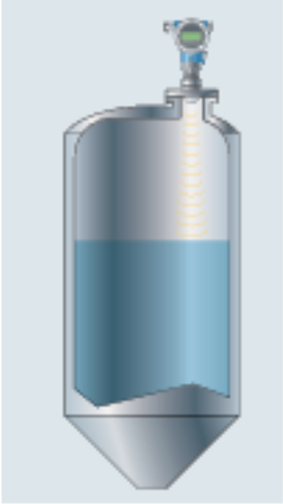
Hydrostatic (Pressure) Level Management
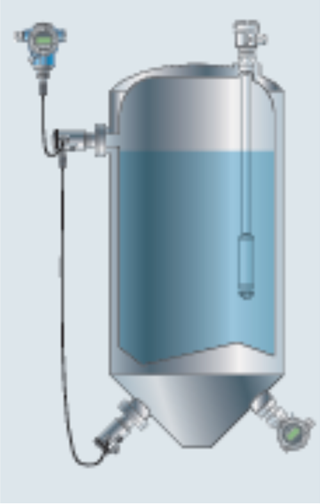
A sensor sits at the bottom of the tank and measures the weight of the liquid above it. More liquid = more pressure. That pressure tells us the level.
Advantages:
- Not affected by foam on the surface
- Not bothered by tank shape or internal obstructions
- Simple and well-established technology
- Reliable in dirty or agitated tanks.
Best suited for:
- Wastewater and effluent tanks
- Foam heavy processes
- Tanks with mixers or internal fittings.
Things to be aware of:
It assumes the liquid density stays fairly constant. If the product gets warmer, cooler, thicker, thinner or changes composition the weight of the product changes – even if the level doesn’t and this can make the readings drift.
The simple solution to this is to install two pressure sensors at different heights in the liquid.
- The bottom sensor measures the total pressure (the full weight of liquid above it)
- The upper sensor measures pressure at a higher point
- They system looks at the difference between the two readings and can calculate the actual liquid density in real time. Once the density is known the system can adjust the level reading automatically.
When is it worth using two sensors:
- Product density changes regularly
- You’re dosing or blending
- Temperature swings are common
- Accuracy is critical.
Why Getting This Right Pays Off
If your plant runs on bad level data, you’ll see it in:
- Unplanned downtime from pump failure
- Product loss from overfill / spills
- Safety & environmental risk
- Higher maintenance from sensor issues or misreads
The right level solution saves time, money and risk over the life of the equipment – often many times over.
If you’re not 100% sure what type of level transmitter belongs on your tanks and vessels, let’s sort it out together. EAS has hands-on experience specifying and installing level measurement solutions that work in the messy, real world of manufacturing plants, councils, and farms.
Call us today on 07 834 0505 or email [email protected] to get a tailored solution that gives you reliable readings – every day.
World Kidney Health Day – Why Getting Checked Matters
On the face of it, you’d think Carey, our Managing Director, was a pretty normal, healthy guy. In fact, he’d probably say he was fitter and more active than plenty of people his age. But in 2017 he discovered he had kidney disease.
There were no obvious warning signs. Carey had been feeling a bit tired and run down for a while, but he put it down to the long hours involved in building a business and raising young kids. Like most parents, being tired just seemed part of the deal.
His wife Gemma encouraged him to get a check-up. Within days the results came back showing his kidney function (eGFR) had dropped to 21%. Carey was in Stage 4 kidney failure.
As you can imagine, it came as a massive shock.
Kidney disease often develops silently, with very few symptoms in the early stages. That’s why awareness and early detection are so important. A simple health check can make all the difference in identifying problems before they become life-threatening.
By 2020 Carey’s kidney function had declined further and he needed to begin peritoneal dialysis. This type of dialysis uses a fluid called dialysate to remove waste and excess fluid from the body. The fluid is placed into the abdominal cavity, where it absorbs waste products before being drained out. Each exchange takes around 30–40 minutes and is typically done several times a day.
Rather than letting dialysis define what he could or couldn’t do, Carey looked for ways to keep living as normally as possible. Being stuck in one place during treatment was frustrating, so he designed a mobile stand that allowed him to move around while connected to dialysis. The idea gave him the freedom to stay active around home and work while undergoing treatment.
Kidney disease currently has no cure, and for many people a transplant becomes the best long-term option. Carey spent time on the transplant waiting list while friends and family went through testing to see if they could become living donors.
During that time he also made lifestyle changes to support his health. That meant fewer beers with the boys, healthier food choices, and switching to an e-bike so he could still get out on the hills without exhausting himself. Staying active, he says, helped not just physically but mentally as well.
Then in 2021 came life-changing news. Carey received a kidney transplant thanks to the generous gift of a kidney from his mate, Piete Vreede.
While recovery requires ongoing medication and monitoring, the difference has been enormous. The freedom from dialysis and the renewed energy that comes with a functioning kidney has had a huge impact on daily life.
Carey continues to share his story to raise awareness of kidney disease and the importance of early detection.
Read more about Carey’s journey
World Kidney Day – Get Your Kidneys Checked
World Kidney Day on 12 March is a reminder that kidney disease can affect anyone — often without warning.
The good news is that simple tests can identify kidney disease early.
If you haven’t had your kidneys checked recently:
-
Visit the Kidney Health NZ Love Your Kidneys website to find free pop-up testing sites near you
-
Or talk to your GP about getting a simple kidney health check.
Early detection could make all the difference.
Fault Finding
Downtime costs money. Lost production, missed deadlines, stressed teams. Faults are inevitable – wasted time isn’t. The key is a structured approach that finds the real cause quickly and fixes it properly the first time.
Here’s how we do it.
The Most Common Industrial Electrical Faults
Understanding what typically goes wrong helps you act faster when it does.
- Open Circuits
Part of the system stops working because it’s not receiving voltage. Often caused by burnt components, open coils, or loose terminals. - Short Circuits
Insulation failure allows current to take the wrong path. This can trip breakers, damage components, and create wider issues. - Low Voltage
Causes relays to chatter and motors to overheat, leading to insulation breakdown and premature failure. - Over Voltage
Excess heat shortens the lifespan of motors, lighting, and sensitive components. - Electro-Mechanical Failures
Worn or defective components — like stuck relays or failed pushbuttons – often show no visible signs.
The EAS Fault Finding Process
We don’t guess. We follow a clear, disciplined process.
- Get the Facts
What was running? What changed? Any recent work done? Safety checks and lockout procedures come first – always. - Observe
Look for loose parts, overheating, unusual smells or sounds. Identify what’s working and what isn’t. - Narrow the Area
Eliminate functioning sections of the circuit to reduce testing time. - Identify Likely Causes
Blown fuses, failed coils, wiring faults, mechanical binding — start with the most probable. - Test Properly
Using the right tools:
-
Voltmeter for supply issues
-
Clamp meter for current draw
-
Ohmmeter for resistance faults
-
Thermal imaging for hidden hot spots
Sectionalise further if needed until the exact fault is located.
- Replace and Verify
Replace the faulty component and test the full system under load. If it’s not right, repeat the process – properly.
Why it Matters
Throwing parts at a problem wastes time and money.
A structured fault-finding process reduces downtime, protects equipment, and prevents repeat failures.
Don’t Let Downtime Run Your Plant
If you’re dealing with repeat trips, overheating motors, nuisance faults, or unexplained breakdowns, it’s time to get to the root cause.
Get in touch with EAS to book a fault-finding assessment and get your plant back running – properly.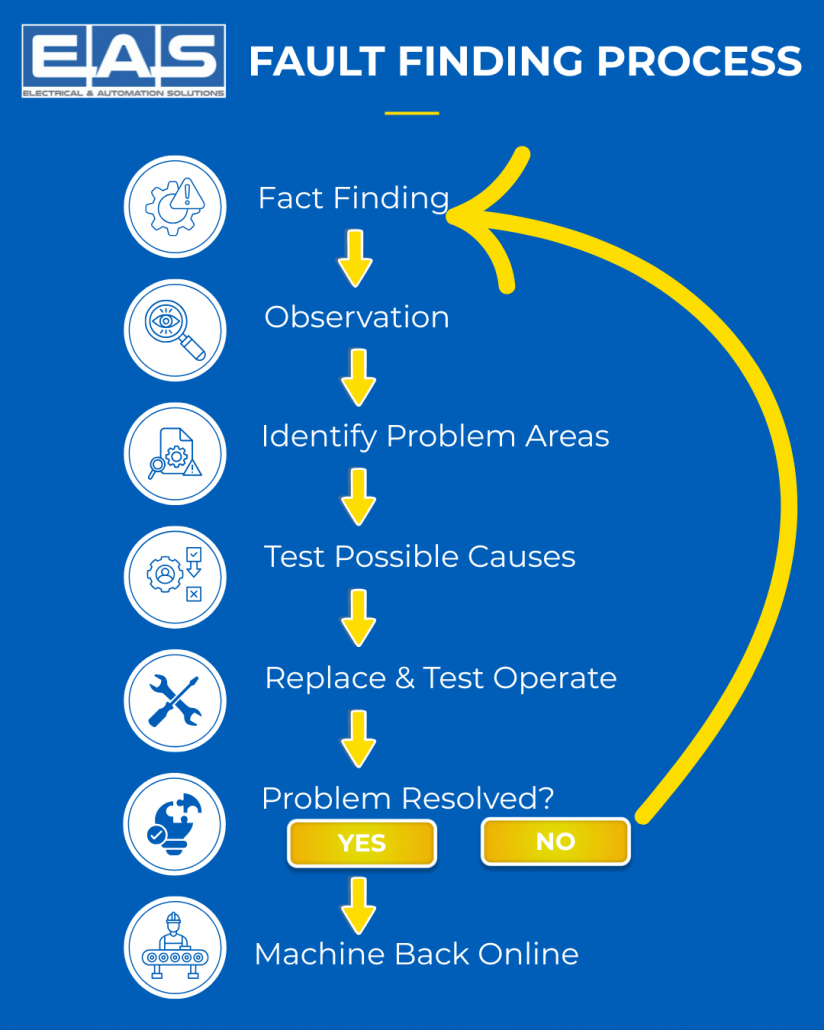


Riddle Answers – November 2025 Newsletter

Witch = 10; Jacko lantern = 5; Bat = 1
Jacko lantern + bat + witch = 16