Fault Finding
Downtime costs money. Lost production, missed deadlines, stressed teams. Faults are inevitable – wasted time isn’t. The key is a structured approach that finds the real cause quickly and fixes it properly the first time.
Here’s how we do it.
The Most Common Industrial Electrical Faults
Understanding what typically goes wrong helps you act faster when it does.
- Open Circuits
Part of the system stops working because it’s not receiving voltage. Often caused by burnt components, open coils, or loose terminals. - Short Circuits
Insulation failure allows current to take the wrong path. This can trip breakers, damage components, and create wider issues. - Low Voltage
Causes relays to chatter and motors to overheat, leading to insulation breakdown and premature failure. - Over Voltage
Excess heat shortens the lifespan of motors, lighting, and sensitive components. - Electro-Mechanical Failures
Worn or defective components — like stuck relays or failed pushbuttons – often show no visible signs.
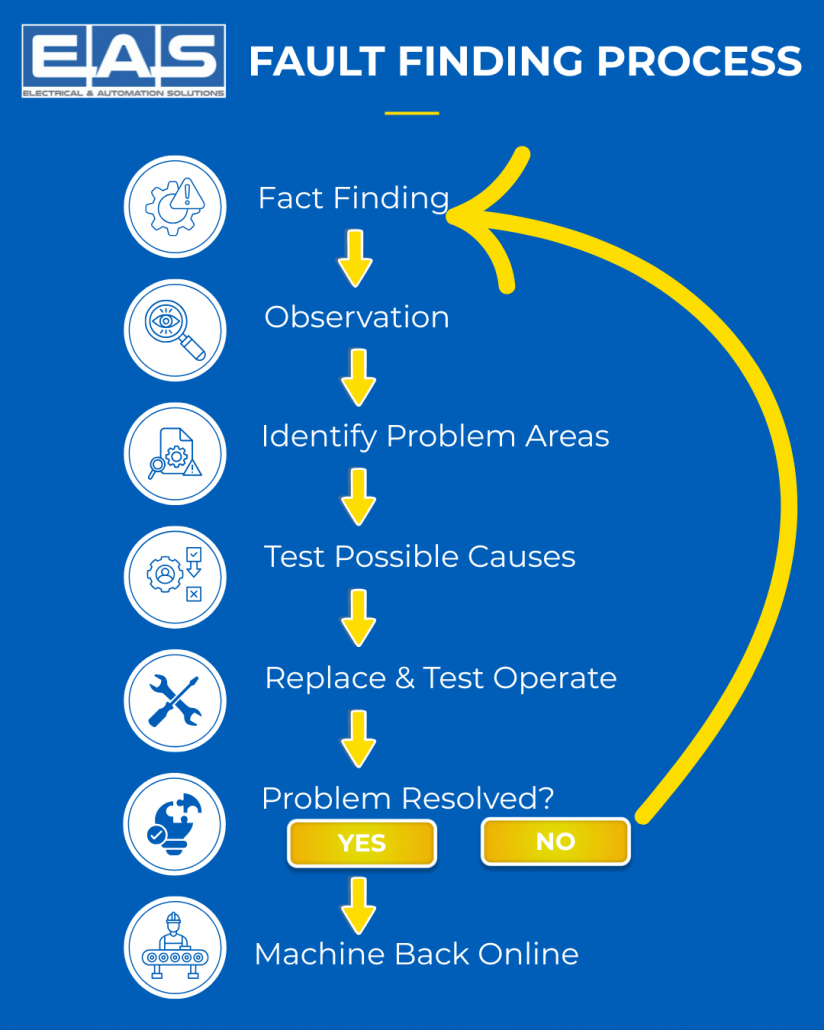
The EAS Fault Finding Process
We don’t guess. We follow a clear, disciplined process.
- Get the Facts
What was running? What changed? Any recent work done? Safety checks and lockout procedures come first – always. - Observe
Look for loose parts, overheating, unusual smells or sounds. Identify what’s working and what isn’t. - Narrow the Area
Eliminate functioning sections of the circuit to reduce testing time. - Identify Likely Causes
Blown fuses, failed coils, wiring faults, mechanical binding — start with the most probable. - Test Properly
Using the right tools:
-
Voltmeter for supply issues
-
Clamp meter for current draw
-
Ohmmeter for resistance faults
-
Thermal imaging for hidden hot spots
Sectionalise further if needed until the exact fault is located.
- Replace and Verify
Replace the faulty component and test the full system under load. If it’s not right, repeat the process – properly.
Why it Matters
Throwing parts at a problem wastes time and money.
A structured fault-finding process reduces downtime, protects equipment, and prevents repeat failures.
Don’t Let Downtime Run Your Plant
If you’re dealing with repeat trips, overheating motors, nuisance faults, or unexplained breakdowns, it’s time to get to the root cause.
Get in touch with EAS to book a fault-finding assessment and get your plant back running – properly.